Table of Contents


Florida’s insurance market is unlike any other state. As of 2026, several major insurers have left the Florida market and many companies have gone into insolvency or receivership. In this climate of shifting carriers and tightening corporate policies, you need more than just an insurance policy — you need an advocate who knows the terrain.
Our legal team brings decades of high-stakes experience to the table, specifically navigating Florida’s complex and often volatile insurance landscape. We have seen the industry’s tactics evolve through every market shift and storm season, and we have the deep-rooted experience required to hold insurance companies accountable. Whether you are facing a delayed claim from a new market entrant or a denied claim from a legacy carrier, our attorneys possess the trial-tested skills to help ensure you aren’t just another number in a corporate spreadsheet.
What Makes Florida Property Insurance Different
In a state where major hurricanes, catastrophic storms, and tropical systems are an annual certainty, having the right property insurance coverage is a necessity. Beyond the shifting insurance market, Florida operates under a unique set of rules that often catch policyholders off guard. In 2026, the following issues remain some of the most common battlegrounds in Florida property insurance disputes:
Hurricane Deductibles: Many Florida homeowners policies include a separate hurricane deductible which can significantly increase your out-of-pocket costs. Levin Litigation can help ensure you are not incorrectly applying this higher deductible to losses that should fall under the standard deductible.
Florida’s Strict Claim-Filing Deadlines: Florida law now imposes strict notice requirements for property claims. In most cases, homeowners must report a new or initial claim within one year of the date of loss. Missing these deadlines can result in an insurer denying the claim based solely on timing.
Optional Sinkhole Coverage (§627.706): Florida law requires insurers to provide coverage for Catastrophic Ground Cover Collapse, but standard sinkhole damage, such as cracking, settling, or foundation movement, is not automatically covered under many policies. We help clients determine whether the damage meets Florida’s strict catastrophic definition or whether additional coverage applies.
Following Hurricane Ian in 2022, thousands of claims were indeed denied or partially unpaid because insurers attributed the damage to storm surge (flooding), which is excluded from standard homeowners’ policies, rather than wind-driven rain.
What Is Covered In a Florida Property Insurance Policy?
A property insurance policy is a contract between you and your insurer. You pay a premium, and in exchange, the insurer promises to cover certain types of damage or other losses to your property, up to the limits stated in your policy. It is different from renters insurance, which only covers the tenant’s personal belongings and liability, not the structure of the building itself.
Knowing some key terms is important to understanding how your policy functions:
- Premiums are the cost of your coverage, usually paid monthly or annually. They are based on factors such as the property’s value, location, and the level of coverage you select.
- Deductibles are the portion of a loss you pay out of pocket before your insurance coverage kicks in. Choosing a higher deductible can reduce your premium, but increases your out-of-pocket costs if a claim arises.
- Coverage limits are the maximum amounts the insurer will pay for a covered loss. Separate limits may apply to the property itself, contents, or liability protection.
- Covered perils are the specific events your policy protects against, such as fire, wind, or hail. Damage from events not listed as covered perils typically isn’t included.
- Exclusions are situations or types of damage that your policy does not cover. Every policy has exclusions, which set the boundaries of what the insurer is responsible for.
Many Florida homeowners are underinsured because their coverage hasn’t kept pace with rapidly rising construction costs. This creates coinsurance penalties where insurers can reduce your payout if you’re underinsured.
What Does Property Insurance Cover in Florida?
While coverage varies by insurer and property type, most standard homeowners insurance policies and commercial property insurance policies include several core areas:
- Structure coverage: Protects the building itself from sudden, accidental damage caused by covered events like fire, lightning, wind, or hail. This includes walls, roofs, floors, and built-in fixtures.
- Contents coverage: Covers personal property or business assets inside the building, such as furniture, electronics, equipment, or inventory. Depending on your policy, contents may be reimbursed at replacement cost value (the amount to repair or replace without factoring in depreciation) or actual cash value (the current value accounting for wear and tear).
- Liability coverage: Provides financial protection if someone suffers a bodily injury on your property and sues you. This can help cover medical expenses, legal fees, and court judgments up to your policy limits.
- Additional Living Expenses (ALE) or Business Interruption (BI): If the property becomes uninhabitable or unusable due to a covered loss, these coverages help pay for temporary housing, operating expenses, or lost income until repairs are complete.
These policies focus on sudden and accidental damage, rather than ongoing maintenance issues or wear and tear. While this forms the foundation of most property protection, there are limits to what a standard policy covers, and some types of damage or events may not be included.
Covered Perils in Florida Property Insurance Claims
Florida HO-3 (homeowners) and DP-3 (dwelling) policies commonly cover many sudden, accidental losses; however, coverage depends heavily on the cause of the damage and policy exclusions. Examples of losses that are often covered include:
- Fire and lightning
- Windstorm and hail (hurricane deductible may apply)
- Explosions
- Theft and vandalism (coverage may be limited if the home is vacant)
- Sudden water damage from plumbing failures or appliance discharge (roof leaks are frequently disputed depending on cause)
- Falling objects
- Weight of ice, snow, or sleet
- Certain types of “collapse,” as defined by the policy

What Florida Property Insurance Often Doesn’t Cover
Even comprehensive policies have gaps. Commercial property insurance and homeowners insurance typically do not cover:
- Most standard policies exclude flooding from storms or rising water. Flood coverage is usually purchased separately through the National Flood Insurance Program or private insurers.
- Damage from sinkholes, earthquakes, or other ground shifts is typically excluded unless added through an endorsement. Due to limestones, Florida sees many sinkhole occurrences; however, not all sinkholes are covered equally. Insurance companies often call these sinkhole defects ‘settling’ or ‘construction defects’ to avoid a payout.
- Wear and tear, mold caused by neglect, termite or pest damage, and other maintenance problems are not covered. Note that insurers will search for any evidence of pre-existing issues. A roof with worn shingles that sustains hurricane damage may be partially or fully denied based on pre-existing deterioration.
- Valuable items like jewelry, artwork, collectibles, or commercial equipment may have coverage limits or require separate policies.
As of 2026, private flood insurance premiums have increased 400-600% in high-risk Florida zones, and NFIP (National Flood Insurance Program) policies are capped at $250,000 for dwelling coverage, which is insufficient for most Florida homes. Following Hurricane Ian’s losses, Florida passed legislation making flood disclosure requirements stricter for home sales. While these laws protect new buyers from walking into a lemon, they do nothing for the hundreds of thousands of people who already own homes in Florida.
Talk To an Experienced Lawyer About Your Case.
100% Confidential. No obligation. No fees.

How the Property Insurance Claims Process Works
When your property is damaged, the claims process is how your insurer evaluates the loss and decides what it will pay. While each insurer may handle claims differently, the process generally follows these steps:
- Notification: You report the damage to your insurer, who opens a claim file. Florida law requires insurers to acknowledge receipt of a claim within seven days.
- Investigation: The insurer assigns an adjuster to inspect the property, document the damage, and determine the cause and scope of the loss. You may be asked to provide photos, receipts, or other records. Inspections are generally expected to be completed within 30 days of receiving all necessary information.
- Evaluation and Settlement: The insurer calculates the amount it will pay based on your coverage, limits, deductibles, and whether items are valued at replacement cost or actual cash value. Florida law generally requires insurers to pay or deny the claim, or undisputed portions, within 90 days after receiving notice. If only part of your claim is approved, the insurer must provide a written explanation citing your policy.
- Payment and Repair: Once the claim is approved, you receive payment and can move forward with repairs or replacement. At this stage, you should be sure to keep detailed records, as some reimbursements may occur after work is completed.
Unlike most states, Florida law imposes strict deadlines on insurers and creates penalties for non-compliance. Understanding these requirements is critical to protecting your rights.
What Are Your Options If You Face Problems With Your Claim?
Even with a clear policy and thorough documentation, property owners sometimes encounter issues that prevent them from receiving full compensation. Some delays or requests for additional information are normal, such as when insurers are handling many claims after a major storm. However, certain problems may indicate a more serious issue:
- Delays: Routine delays can occur, but concern arises if the insurer seems to be stalling unnecessarily, repeatedly requests redundant documentation, or ignores reasonable timelines, blocking progress on your claim.
- Denials: Claims are sometimes denied because the insurer believes the damage isn’t covered. Problems arise when denials are based on misinterpretation of your policy, errors, or refusal to pay for damage that should clearly be covered.
- Underpayments: Even accepted claims can result in less than full compensation. This may happen if the insurer undervalues replacement costs, misapplies depreciation, or omits damaged property, leaving you with an inadequate settlement.
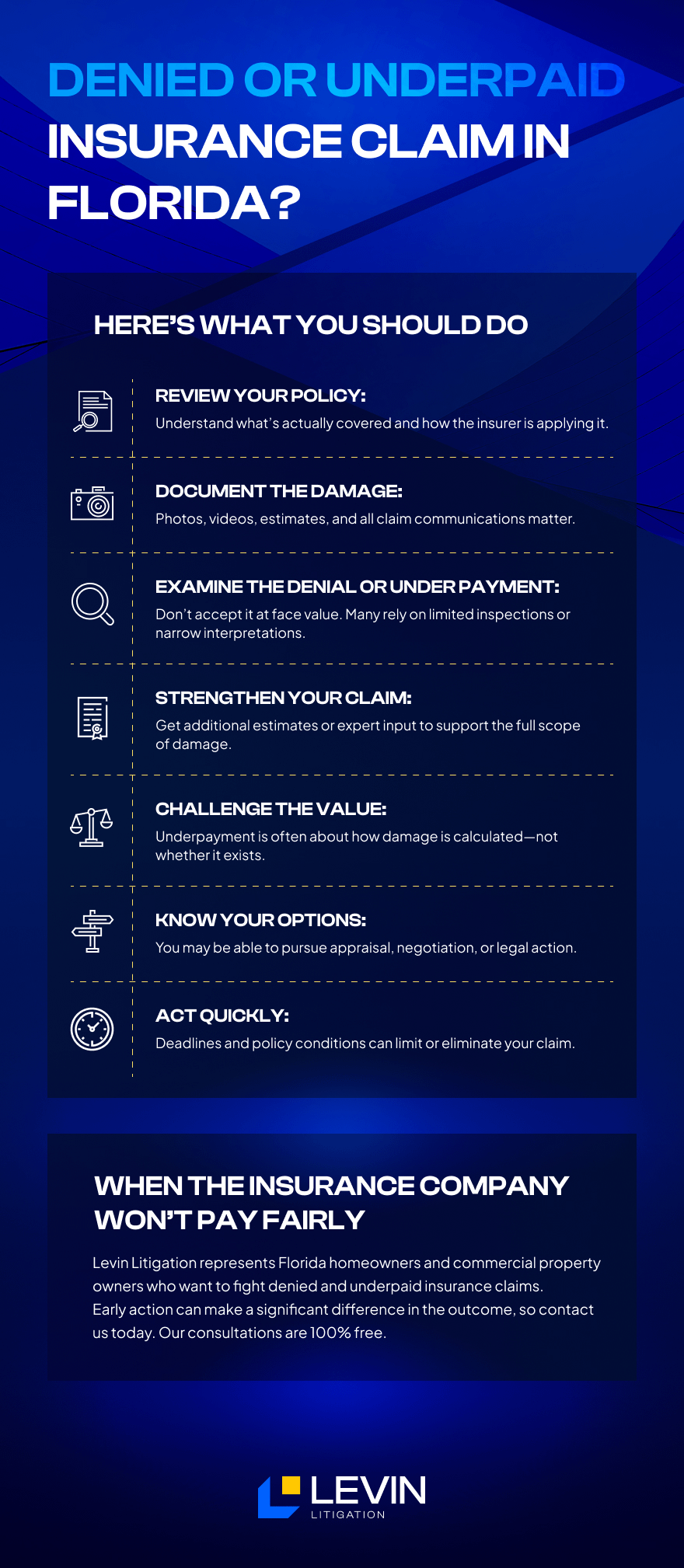
When these issues occur, you may be left in limbo, unsure whether your claim will be approved, or be responsible for costly repairs and replacement expenses out of pocket. The good news is that it is often possible to appeal an insurer’s decision or dispute an underpayment. However, navigating that process without proper guidance can jeopardize your chances of success.
How a Property Damage Insurance Lawyer Can Help
When you face issues with a claim, a property insurance attorney brings expertise and tools that property owners typically don’t have on their own:
- Policy interpretation: Lawyers know how to read and interpret complex policy language, ensuring coverage obligations are fully understood and enforced.
- Identifying insurer tactics: Attorneys are familiar with common strategies insurers use to undervalue or delay claims and can anticipate and counteract them.
- Navigating appeals and disputes: Legal professionals can manage the appeals process, negotiations, and formal dispute resolution, increasing the likelihood that you receive the compensation you are entitled to.
- Maximizing recovery: Attorneys help document damages properly, calculate replacement costs versus depreciation, and ensure no aspect of your claim is overlooked, protecting your financial interests.
Working with a lawyer ensures that your claim is handled efficiently, your rights under Florida law are upheld, and you are positioned to achieve the best possible outcome for your property.
Unfair Delay, Denial, or Underpayment? Contact Levin Litigation
When your property insurance claim stalls, is denied, or comes back with a payment that doesn’t cover what your policy promises, it can leave you unsure where to turn. These issues aren’t just procedural; they can leave you responsible for significant repair costs and uncertain whether your insurer will honor its obligations.
The good news is that you do not have to face that alone. At Levin Litigation, we understand how insurance companies think and what it takes to push back. We focus on results, not red tape, and we take on insurers that delay, deny, or underpay claims. Our attorneys can review your policy, identify where the insurer has fallen short, and help you pursue the full compensation your policy entitles you to.
Contact us today to schedule a free consultation and explore your options.